Entries by drcraigharrison

EP #149

The Curious Mind #07 - Moments of Gratitude, Trips Abroad, Finding Joy, Negative Parent Behaviour, & more


Share on facebook


Share on twitter


Share on linkedin

Head of coaching at Birkenhead United FC in Auckland, New Zealand and Co-founder of Player Development Project, Dave Wright (@davewright07), rejoins me for another episode of The Curious Mind.

We discuss our experiences in youth sport over the past couple of months, including a recent trip Dave took to Tonga and what he learnt from it, the importance of joy and how to find it, and the continued rise in negative parent behaviour. 

Enjoy!

Sign up for Craig’s newsletter (Beyond the Game) at athletedevelopmentproject.com/newsletter

Get Craig to speak at your club or school here

Connect with Craig:

Instagram: instagram.com/drcraigharrison/
Facebook: facebook.com/drcraigharrison
Twitter: twitter.com/drcraigharrison

Listen to this episode on Apple Podcasts, Spotifyor your favourite podcast platform.

Beyond the Game free newsletter. Sign up now for your weekly dose of insight to help your athletes thrive!


EP #148

Mike Hester on the Evolution of Rugby in New Zealand


Share on facebook


Share on twitter


Share on linkedin

“Fun is a fleeting moment. Joy is something that’s enduring, something that brings you back.”

Mike Hester works for New Zealand Rugby and is responsible for leading their approach to the evolution of the game at participation level. Prior to this role, Mike spent 28 years at the New Zealand Defence Force where he worked as a Career and Talent Manager.

Mike is also a former FIFA referee and has officiated at the highest level at pinnacles events across the world, including the Beijing Olympic Games in 2008 and the FIFA World Cup in South Africa in 2010.

On the show today, Mike shares some of the skills required for a referee to be at their best in emotionally volatile sporting environments and why investing into early stage referees is so important for the game of rugby. We also talk about the shift NZ Rugby is making from a game-centred approach to one that is more participant-centred.

The work Mike is doing is challenging not only the foundations of New Zealand’s national game but also the fabric of the culture it sits within.

Enjoy!

Sign up for Craig’s newsletter (Beyond the Game) at athletedevelopmentproject.com/newsletter

Get Craig to speak at your club or school here

Connect with Craig:

Instagram: instagram.com/drcraigharrison/
Facebook: facebook.com/drcraigharrison
Twitter: twitter.com/drcraigharrison

Listen to this episode on Apple Podcasts, Spotifyor your favourite podcast platform.

Beyond the Game free newsletter. Sign up now for your weekly dose of insight to help your athletes thrive!


EP #147

Dane Baker on Fuelling for Performance, Fad Diets, and Low Energy Availability in Sport


Share on facebook


Share on twitter


Share on linkedin

Dane Baker is a Performance Dietitian who has worked extensively with New Zealand’s elite athletes and organisations over the past 15 years, including the Chiefs, Blues, Black Ferns 7s, NZ Hockey and NZ Swimming.  He was also the NZ team dietitian for the Rio Olympics and Gold Coast Commonwealth Games.

Dane is an active researcher in the field of RED-s, a lecturer at the University of Otago and has a leadership role as part of WHISPA, a specialist group dedicated to optimising female health and performance at High performance Sport New Zealand.  He also leads the nutrition provision for the HPSNZ core knowledge coach education program.

In this wide ranging conversation, Dane and I discuss how to properly fuel a developing athlete’s performance, fad diets and the influence they are having on our kids, Dane’s love of fishing, and the dangers of low energy availability in sport. We start the show hearing about Dane’s formative years growing up playing golf in West Auckland.

Enjoy!

Sign up for Craig’s newsletter (Beyond the Game) at athletedevelopmentproject.com/newsletter

Get Craig to speak at your club or school here

Connect with Craig:

Instagram: instagram.com/drcraigharrison/
Facebook: facebook.com/drcraigharrison
Twitter: twitter.com/drcraigharrison

Listen to this episode on Apple Podcasts, Spotifyor your favourite podcast platform.
Beyond the Game free newsletter. Sign up now for your weekly dose of insight to help your athletes thrive!


EP #146

Kylie Cox on the Importance of a Healthy and Regular Menstrual Cycle


Share on facebook


Share on twitter


Share on linkedin

We all have times in our lives that change us. Watershed moments that force us into thinking differently. Kylie Cox had one of these very moments a few years ago while training for an Ironman World 70.3 Age Group Championship. Despite continuing to perform in training, a number a life stressors coincided with a heavy training load. She became concerned about how her health might impact her menstrual cycle and sought help.

Now, after exercising her own curiosity and earning a Master’s degree focusing on energetic injuries, Kylie is passionate about helping young athletes and their families understand what it really means to stay healthy.

Kylie also works a the physiotherapist for Netball New Zealand’s secondary school programme and recently developed the first national resource on female athletic health for NetballSmart.

We start the show hearing more about Kylie’s story.

Enjoy!

Sign up for Craig’s newsletter (Beyond the Game) at athletedevelopmentproject.com/newsletter

Get Craig to speak at your club or school here

Connect with Craig:

Instagram: instagram.com/drcraigharrison/
Facebook: facebook.com/drcraigharrison
Twitter: twitter.com/drcraigharrison

Listen to this episode on Apple Podcasts, Spotifyor your favourite podcast platform.

Beyond the Game free newsletter. Sign up now for your weekly dose of insight to help your athletes thrive!


EP #145

Mark Upton and Ken Willner on Promoting Freedom, Creativity, Collaboration and Competition


Share on facebook


Share on twitter


Share on linkedin

My conversation this week is with Mark Upton and Ken Willner.

Mark is passionate about supporting people’s WayFinding endeavours by facilitating the emergence of new connections, new capacities, and meaningful stories and refections as we journey together. He has a particular interest in helping people find their way in sport. You can find Mark’s work @ myfastestmile.com

Ken Willner is a sports photographer passionate about keeping children in sport. Through collaboration with international and local professionals, Ken provides a fresh approach to helping young people flourish in sports. You can find Ken’s work @ yellowforyelling.com

On the show today, Mark and Ken share their Game Hubs idea. Game Hubs are local community spaces that promote freedom, creativity, collaboration and competition through games. They embrace the voices and choices of young people, are low cost, and rather than coaching, call for adults to just facilitate play. 

We start our conversation hearing from Ken and his thoughts on the intensity of emotion parents bring to sport.

Enjoy!

Sign up for Craig’s newsletter (Beyond the Game) at athletedevelopmentproject.com/newsletter

Get Craig to speak at your club or school here

Connect with Craig:

Instagram: instagram.com/drcraigharrison/
Facebook: facebook.com/drcraigharrison
Twitter: twitter.com/drcraigharrison

rch findings have had a huge impact on the way I think about environments for developing skilled, creative and resilient athletes and so, heading into the winter season, I thought I’d share our conversation again.

Sam now works as a coach developer in the talent pathway for the AFL. We pick the conversation up hearing Sam talk about how experiencing some of the darker side of sport drives the work that he loves today.

Enjoy!

Sign up for Craig’s newsletter (Beyond the Game) at athletedevelopmentproject.com/newsletter

Host Craig to speak at your club or school here

Connect with Craig:

Instagram: instagram.com/drcraigharrison/
Facebook: facebook.com/drcraigharrison
Twitter: twitter.com/drcraigharrison

Listen to this episode on Apple Podcasts, Spotifyor your favourite podcast platform.

Beyond the Game free newsletter. Sign up now for your weekly dose of insight to help your athletes thrive!


EP #144

Samuel McKenzie - The 1st XV Rugby Experience in New Zealand (Repost)


Share on facebook


Share on twitter


Share on linkedin

This week I’m winding the clock back to May 2020 when I sat down with my good friend Samuel McKenzie.

In 2019, Sam completed his Master’s degree at AUT University focusing on 1st XV rugby players’ perceptions of their coaching environment. Sam’s research findings have had a huge impact on the way I think about environments for developing skilled, creative and resilient athletes and so, heading into the winter season, I thought I’d share our conversation again.

Sam now works as a coach developer in the talent pathway for the AFL. We pick the conversation up hearing Sam talk about how experiencing some of the darker side of sport drives the work that he loves today.

Enjoy!

Sign up for Craig’s newsletter (Beyond the Game) at athletedevelopmentproject.com/newsletter

Host Craig to speak at your club or school here

Connect with Craig:

Instagram: instagram.com/drcraigharrison/
Facebook: facebook.com/drcraigharrison
Twitter: twitter.com/drcraigharrison

Listen to this episode on Apple Podcasts, Spotifyor your favourite podcast platform.

Beyond the Game free newsletter. Sign up now for your weekly dose of insight to help your athletes thrive!


EP #143

Zane Winslade on Playfulness, Courage, and Developing Mental Toughness


Share on facebook


Share on twitter


Share on linkedin

This week’s conversation is with Zane Winslade.

Zane is the owner of Flow Sport Mental Performance Coaching, and works with athletes from youth to the elite level across multiple codes. Zane has a a Bachelor’s degree in Sports and Leisure Studies, a Graduate Diploma in Teaching and a Master’s degree in Sport Psychology from John F Kennedy University.

On the show today , Zane shares how he works with young people to help them manage their mind and perform as their best self. We also discuss the 3 key principles Zane founded his Mental Toughness Journal for young athletes on.

We start the episode talking about how Zane approaches his own mental game at Brazilian Jujitsu. 

Enjoy!


Sign up for Craig’s newsletter (Beyond the Game) at athletedevelopmentproject.com/newsletter

Get Craig to speak at your club or school here

Connect with Craig:

Instagram: instagram.com/drcraigharrison/
Facebook: facebook.com/drcraigharrison
Twitter: twitter.com/drcraigharrison

Listen to this episode on Apple Podcasts, Spotifyor your favourite podcast platform.

Beyond the Game free newsletter. Sign up now for your weekly dose of insight to help your athletes thrive!


How much is too much? How to balance stress with recovery

How much is too much? How to balance stress with recovery

Training induces stress on the body. For instance, an elevated heart rate during a small-sided game or an accumulation of lactate in the body after a hill running session. Despite discomfort, physiological stress is what elicits adaptation. It creates fatigue, which signals a repair response in the body and the start of the recovery process.
 
However, there’s a pervasive belief in our culture that more is better. That more time, hard work, and effort leads to better outcomes. It’s a belief cultivated by a focus on competition, social status, and winning. And it’s not just about physiological stress. Emotional stress, such as that often associated with a busy schedule, making a team, the expectation and pressure of a big game or event, and thinking “what might happen if I lose”, has ramped up significantly in the lives of young people.
 
The science clearly shows that while stress is a necessary ingredient for development, too much of it can hold an athlete’s progression back, lead to injury, or burn a young athlete out. Stress is cumulative, meaning all stress, regardless of where it comes from, has an impact. For this reason, balancing stress and recovery is critical for an athlete’s healthy development.
 
To help get your head around this idea, consider the following equation:

Health = Stress X Recovery

Remember, stress per see is not a bad thing. As I have already discussed, it in fact drives adaptation. However, a stress-recovery relationship out of balance for too long can cause problems. For instance, following a tournament week when an athlete is physically and mentally exhausted and needs a disparate amount of time to recover. You also see issues during times of accelerated growth, and when environments are designed for performance outcomes at the expense of joy.
 
So let’s check out the different parts of the equation:

Stress

  1. Physical load – this is the total amount of physical activity an athlete is doing per week (measured in hours) and the intensity at which it takes place.
  2. Academic load – this is the amount of academic work an athlete is doing per week (measured in hours) and the intensity at which it is taking place. Presence of internal assessments, assignments, exams and other intra-curricular activities tend to increase the intensity of academic load.
  3. Environmental structure – this is the degree to which the developmental environment is strictly controlled by adults versus set-up for exploration and discovery. Science shows how spending time in playful environments helps a young person manage stress and learn the skills to self-regulate.
  4. Quality of relationships – conflict increases stress. A relationship that is psychologically safe and founded on trust reduces necessary stress.
  5. Stage of development – a critical aspect of youth sport often neglected is the adolescent growth spurt. This is the stage of development between ~11-15 years of age when an athlete is changing rapidly, both physically and mentally. The changes associated with this phase of natural development increase stress. 

Recovery

  1. Sleep – the importance of sleep is undeniable. To borrow from a computer analogy, sleep is the time during which an athlete ‘upgrades their hardware and software”. Insufficient sleep quantity and quality has significant implications for stress tolerance.
  2. Nutrition and hydration – the right nutrients and minerals are essential for healthy growth.
  3. Movement vitamins – I have talked about the importance of movement skill before. But certain types of movement also provide value in recovery.
  4. Social play – play is not only for young children. Social play, which happens when athletes of any age ‘hang out’ with friends away from any organised sport or learning, aids in recovery.

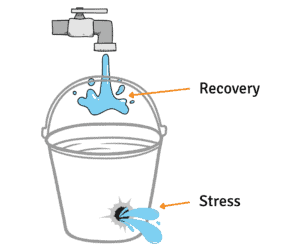
Keep the bucket full

The goal is not to reach a definitive answer here. Development is complex and linear thinking can be dangerous. Instead, the purpose of the equation is to help you support an athlete to “keep their bucket full”. More specifically, in an effort to balance stress with recovery and keep an athlete healthy and playing the sports that they love, it is important be aware of the components of stress that deplete an athlete’s bucket as well as the important recovery mechanisms that fill in back up.


Share on facebook


Share on twitter


Share on linkedin

Get the inside running on developing adaptable, resilient athletes.

Enter your details below to get my free newsletter, Beyond the Game, sent to hundreds of parents and coaches every week straight to your inbox. 


EP #142

The Curious Mind #06 - How Much is Too Much?


Share on facebook


Share on twitter


Share on linkedin

Head of coaching at Birkenhead United FC in Auckland, New Zealand and Co-founder of Player Development Project, Dave Wright (@davewright07), rejoins me for another episode of The Curious Mind.

How much is too much? In this conversation, we dig into training load. We discuss what load is, where it comes from, how it changes across developmental stages, the danger of doing too much, and how to start thinking about managing it.

Enjoy!

Sign up for Craig’s newsletter (Beyond the Game) at athletedevelopmentproject.com/newsletter

Get Craig to speak at your club or school here

Connect with Craig:

Instagram: instagram.com/drcraigharrison/
Facebook: facebook.com/drcraigharrison
Twitter: twitter.com/drcraigharrison

Listen to this episode on Apple Podcasts, Spotifyor your favourite podcast platform.

Beyond the Game free newsletter. Sign up now for your weekly dose of insight to help your athletes thrive!


EP #141

Reed Maltbie on Emotional Fitness, Living a Life in Balance, and the Spartan Mindset


Share on facebook


Share on twitter


Share on linkedin

Living a life in balance is about finding flow. It’s about capitalising on all of the things that make you a better person without one of them taking over the flow.

My guest on today’s show is Reed Maltbie, and he’s a master at helping athletes find flow.

With a Master’s degree in sports psychology and early childhood development and 30 years of professional coaching experience, Reed has dedicated his life to creating the very best environments for athletes of all ages to achieve peak performance, on and off the sports field.

Reed has worked with a variety of sports organisations including the Gaelic Games Association, England Sevens, Soccer Shots, Sport New Zealand, Player Development Project, US Sailing, Soccer Canada, and PGA of Canada.

His latest book, The Spartan Mindset, due out in April 2023, Reed focuses on the impact of language on performance. It is a must-read for anyone who strives to be a more effective and supportive communicator in the classroom, on the sports field, at the office, and beyond.

We begin this conversation talking about the power of emotional fitness and how Reed goes about developing it.

Enjoy!

Sign up for Craig’s newsletter (Beyond the Game) at athletedevelopmentproject.com/newsletter

Get Craig to speak at your club or school here

Connect with Craig:

Instagram: instagram.com/drcraigharrison/
Facebook: facebook.com/drcraigharrison
Twitter: twitter.com/drcraigharrison

Listen to this episode on Apple Podcasts, Spotifyor your favourite podcast platform.

Beyond the Game free newsletter. Sign up now for your weekly dose of insight to help your athletes thrive!