
How much is too much? How to balance stress with recovery
Training induces stress on the body. For instance, an elevated heart rate during a small-sided game or an accumulation of lactate in the body after a hill running session. Despite discomfort, physiological stress is what elicits adaptation. It creates fatigue, which signals a repair response in the body and the start of the recovery process.
However, there’s a pervasive belief in our culture that more is better. That more time, hard work, and effort leads to better outcomes. It’s a belief cultivated by a focus on competition, social status, and winning. And it’s not just about physiological stress. Emotional stress, such as that often associated with a busy schedule, making a team, the expectation and pressure of a big game or event, and thinking “what might happen if I lose”, has ramped up significantly in the lives of young people.
The science clearly shows that while stress is a necessary ingredient for development, too much of it can hold an athlete’s progression back, lead to injury, or burn a young athlete out. Stress is cumulative, meaning all stress, regardless of where it comes from, has an impact. For this reason, balancing stress and recovery is critical for an athlete’s healthy development.
To help get your head around this idea, consider the following equation:
Health = Stress X Recovery
Remember, stress per see is not a bad thing. As I have already discussed, it in fact drives adaptation. However, a stress-recovery relationship out of balance for too long can cause problems. For instance, following a tournament week when an athlete is physically and mentally exhausted and needs a disparate amount of time to recover. You also see issues during times of accelerated growth, and when environments are designed for performance outcomes at the expense of joy.
So let’s check out the different parts of the equation:
Stress
- Physical load – this is the total amount of physical activity an athlete is doing per week (measured in hours) and the intensity at which it takes place.
- Academic load – this is the amount of academic work an athlete is doing per week (measured in hours) and the intensity at which it is taking place. Presence of internal assessments, assignments, exams and other intra-curricular activities tend to increase the intensity of academic load.
- Environmental structure – this is the degree to which the developmental environment is strictly controlled by adults versus set-up for exploration and discovery. Science shows how spending time in playful environments helps a young person manage stress and learn the skills to self-regulate.
- Quality of relationships – conflict increases stress. A relationship that is psychologically safe and founded on trust reduces necessary stress.
- Stage of development – a critical aspect of youth sport often neglected is the adolescent growth spurt. This is the stage of development between ~11-15 years of age when an athlete is changing rapidly, both physically and mentally. The changes associated with this phase of natural development increase stress.
Recovery
- Sleep – the importance of sleep is undeniable. To borrow from a computer analogy, sleep is the time during which an athlete ‘upgrades their hardware and software”. Insufficient sleep quantity and quality has significant implications for stress tolerance.
- Nutrition and hydration – the right nutrients and minerals are essential for healthy growth.
- Movement vitamins – I have talked about the importance of movement skill before. But certain types of movement also provide value in recovery.
- Social play – play is not only for young children. Social play, which happens when athletes of any age ‘hang out’ with friends away from any organised sport or learning, aids in recovery.
Keep the bucket full
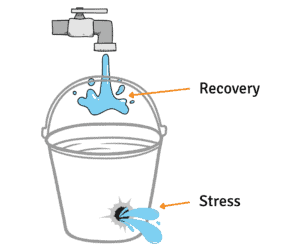
The goal is not to reach a definitive answer here. Development is complex and linear thinking can be dangerous. Instead, the purpose of the equation is to help you support an athlete to “keep their bucket full”. More specifically, in an effort to balance stress with recovery and keep an athlete healthy and playing the sports that they love, it is important be aware of the components of stress that deplete an athlete’s bucket as well as the important recovery mechanisms that fill in back up.
Share on facebook
Share on twitter
Share on linkedin
Get the inside running on developing adaptable, resilient athletes.
Enter your details below to get my free newsletter, Beyond the Game, sent to hundreds of parents and coaches every week straight to your inbox.